Sunday, 26 September 2021

Workhouse runs - Uckfield - Site of Union Workhouse

My 3 previous posts visited the parish workhouses of Uckfield, Framfield and Buxted. In the 1830s, these were superseded by a single, Union workhouse at Uckfield located in Ridgewood around the place where Wares Road and Highview Lane meet.

Uckfield Union Workhouse

The Union Workhouse

Uckfield Poor Law Union was formed from about a dozen parishes on 25th March 1835. A new Uckfield Union workhouse, 3 stories tall and designed to accommodate 350 inmates, was built in 1838-9.  Ron Martin's article "Casual Wards at Uckfield Union Workhouse" in Hindsight Volume 2 tells us that facilities included: male and female accommodation, dining room kitchen, offices and board room, nursery, wash-house, disinfectant house and workshops. The presence of a school mistress in the 1881 census suggests a classroom.

Site of the Union Workhouse. Pleasant houses and colourful gardens.

It has since been demolished and pleasant-looking houses with colourful gardens now fill the site. The area between the workhouse and New Road comprised fields in which the inmates would have been expected to grow vegetables in the same stubborn clay that Wares Pottery used to make their tiles and pots.

Looking at the old censuses, plenty of local names jump off the page.  One name, in particular catches my attention.

1841 - Charlotte Langridge, F, age 10, born Sussex

There are Langridges from the Dane Hill part of my family tree. Could Charlotte be connected somehow? How did she end up in the workhouse?

The 1851 census shows that she is still at the union workhouse and that other Langridges have arrived. namely 68-year old William Langridge and his wife. William was born in the parish of Newick and married Fletching girl, Martha Thorp in  September 1807. He worked as a farm labourer and they raised a family in Fletching before ending their days in the Uckfield Union workhouse.

Charlotte Maria's record on the Weald website shows that she was William and Martha's grandchild. Their first child, Jane, was born in 1807, not long after they married. She had three illegitimate children with different men. The first two, Philip and John, were born and died in the Fletching workhouse. The third, Charlotte Maria survived and must have been transferred to the Union workhouse in Uckfield before she was 10 years old.

So are we related? A bit of burrowing on the Weald website gave me the answer. Going back six generations from Charlotte Maria, I find myself in the England of 11th September 1675. The civil war had ended 24 years previously and King Charles II is on the throne. In London, the reconstruction of St. Paul's Cathedral has just started. In the rather more modest surroundings of St Andrew & St Mary Church, Fletching, John Langridge (born 1655 in Horsted Keynes) married Anne Hysted (born 1655). They had six children. The second youngest, William (born 1862) was Charlotte Marie's ancestor. The youngest, George (born 1863) was mine. So we are related. I am assuming that Charlotte ended up in the workhouse because she was illegitimate. There is illegitimacy in my Langridge line too - but my ancestor was lucky, she and the father of her children moved in together and later married and, as far as I know, no one ended up in the workhouse.

The Casual Wards block

Highview Lane, which led down to the workhouse's casual wards.

The Hindsight article goes on to explain that, about 60 years after the Union workhouse was built, the casual wards block (vagrants lodge) was added. This long, low building had a central corridor with individual cells for the overnight occupants.  Male and female accommodation were separate.  There were 7 cells for men. Each had an adjacent stone-breaking cell. Cells had hooks for hammocks and high windows.  The 2 women's cells were similar but with no stone-breaking cell.

The last run

The last of my workhouse runs took me to the site of the Uckfield Union workhouse. by finding out a little about the inmates I found a distant relation whose family, like mine on the Langridge side, were agricultural labourers. I saw how small differences in a family's fortunes and maybe a bit of luck enabled my ancestors to scratch along OK while she ended up in a workhouse, a significant distance from her home village. Coming up to date, so far I have been one of the lucky ones but I am all too aware that this could change with a fall in share prices and a couple of other quirks of fate, which is why I have been running in aid of Shelter.

https://raiseyourrun.shelter.org.uk/fundraising/wendy-tagg-in-aid-of-shelter

References

http://www.workhouses.org.uk/Uckfield/

Ron Martin (1996) "Casual Wards at Uckfield Union Workhouse" Hindsight Volume 2

Uckfield Union Workhouse censuses https://www.theweald.org/P2.asp?PId=Uc.Whouse

Charlotte Maria Langridge https://www.theweald.org/N10.asp?NId=120011699

William Langridge https://www.theweald.org/N10.asp?NId=120010832

Martha Langridge https://www.theweald.org/N10.asp?NId=120011220

Joseph Langridge (my ancestor) https://www.theweald.org/N10.asp?NId=120011069

Plantagenet Somerset Fry (1990), The Kings and Queens of England and Scotland, pg 140

Sunday, 19 September 2021

Workhouse Runs - Buxted

 Buxted is an attractive village surrounded by farmland. However, not everyone would have been able to work and the parish had 25 workhouse places. 

One of the fields to the South East of the village once contained Workhouse Farm.  The idea was that inmates would provide some of their own food, reducing running costs. In 1841 the Workhouse Farm was home to eight people, in three groups:

Group 1:

  • Thomas Berrick, M, Head, age 79, born Sussex
  • Frances Berrick, F, [Wife], age 61, born Sussex
  • Charles Berrick, M, [Grand-son], age 16, born Sussex
  • Edward Berrick, M, [Grand-son], age 8, born Sussex

Group 2:

  • William Durrant, M, Head, age 40 to 44, born Sussex
  • Sarah Durrant, F, [Mother], age 80 to 84, born Sussex

Group 3:

  • Hannah Seymer, F, Head, age 50 to 54, born Sussex
  • Thomas Turner, M, age 75 to 79, born Sussex; occupation: servant
I think that the numbers are much lower than expected because, in 1841, the authorities were probably already moving inmates to the Uckfield Union workhouse. The 8 people left were mostly very young or old like Thomas Berrick, aged 79, his wife and two grandsons. Were they breaking up families, leaving just the youngest and oldest at the farm? There are a few people with the same surname in the Union workhouse:
  • John Berrick, M, age 13, born Sussex
  • Ann Durrant, F, age 50 to 54, born Sussex, possibly the same Anne Durrant that was there 10 years later
  • Maria Turner, F, age 25 to 29, born Sussex

By 1851, the farm was no longer a workhouse.  Those who could not support themselves ended up in Uckfield's Union workhouse.

Buxted's Almshouses

However, a generous act improved the lot of some Buxted people. The Post Office Directory of 1874 tells us:

The Buxted almshouses, containing four tenements, two for single people and two for married couples, were built by Lady Catherine J. V. Harcourt, A.D. 1864.

Plaque showing Lady Harcourt's initials and A.D. 1864

Lady Harcourt who, with her husband, had inherited Buxted House from her father, The 3rd Lord Liverpool.

Ironically, this was the same Lord Liverpool (1784-1851) who,  according to Farrant (2001) "ordered the removal of all but one of the houses in 'Buxted Street', so as to enlarge the park and leave in isolation the church and the house immediately to the West of it."  The survey of 1798 tells us that there were 10 tenants.  According to Taylor (1986) "Lord Liverpool then refused to carry out any repairs to the properties and they gradually fell into decay. The occupants were forced to leave, the houses were demolished and by 1836 there was nothing left to be seen of the old village."

There would have been a cottage between me and the church and more to its right.

In modern times, there are too many people who can relate to these bygone villagers who were living in tumbledown accommodation, which is why I am running to raise money for Shelter.

https://raiseyourrun.shelter.org.uk/fundraising/wendy-tagg-in-aid-of-shelter

References

The workhouse - http://www.workhouses.org.uk/parishes/

1841 census - workhouse farm - https://www.theweald.org/P2.asp?PId=Bu.WorkHF

Buxted Almshouses - https://www.theweald.org/P2.asp?PId=Bu.AlmsHo

Census for Uckfield Union Workhouse - https://www.theweald.org/P2.asp?PId=Uc.Whouse

Catherine Julia (Jenkinson) Harcourt (1811 - 1877) https://www.wikitree.com/wiki/Jenkinson-541

John Farrant (2001) Sussex Depicted, pg 186

Rupert Taylor (1986) The East Sussex Village Book, pg 34

Sunday, 12 September 2021

Workhouse Runs - Framfield workhouse

It was the perfect moment for a run. The sun was rising and beginning to burn off the mist lying in the valleys.  I headed East from home and quickly found myself running along Sandy Lane, with pretty cottages dotted between rolling fields. 

Framfield's former workhouse, now delightful homes.

Turning left, I pass Brett's cottages. Just under 200 years ago these cottages were a workhouse. From the 1700s, work houses accommodated those unable to support themselves. In 1841, the 11 inmates ranged from sixtysomething farm labourer, Gabriel Gladman, to 3-year old Harriet Towner:

  • James Waller, M, Head, age 30 to 34, born Sussex; occupation Relieving Officer
  • Mary Waller, F, [Wife], age 40 to 44, born Sussex
  • William Waller, M, [Son], age 8, born Sussex
  • Gabriel Gladman, M, age 60 to 64, born Sussex; occupation: farm labourer
  • James Banks, M, age 17, born Sussex
  • Henry Jones, M, age 17, born Sussex
  • John Potter, M, age 7, born Sussex
  • Philly Tomsett, F, age 30 to 34, born Sussex
  • Margaret Hartfield, F, age 10, born Sussex
  • Louisa Hobbs, F, age 10, born Sussex
  • Jane Day, F, age 7, born Sussex
  • Caroline Towner, F, age 5, born Sussex
  • Harriet Towner, F, age 3, born Sussex
  • Iona Wicks, F, age 5, born Sussex

The Old Warden's Cottage

Presumably the Relieving Officer and his family lived in the part of the building now known as The Old Warden's Cottage.

There doesn't seem to be that many people in the workhouse. I suspect that most of Framfield's "paupers" had already be sent to the big Union Workhouse in Uckfield's.  As I scanned down the 1941 list of inmates for this establishment, two names leapt out at me.

  • Mary Towner, F, age 25 to 29, born Sussex
  • William Towner, M, age 1, born Sussex

Was Mary the mother of little Caroline and Harriet? If so it seems to be extraordinarily cruel to split the little children from their mum. Their father was already gone - had he died? deserted the family? Unable to support them?  Whichever it was, it seems very harsh to split the family further.

Framfield's old workhouse is South East of the railway between Uckfield and Buxted.

Sadly, people are still being pushed out of their home towns and villages by circumstances beyond their control, which is why I am running to raise money for Shelter. 

https://raiseyourrun.shelter.org.uk/fundraising/wendy-tagg-in-aid-of-shelter 

References

Census information from 1841 - Framfield Workhouse https://www.theweald.org/P2.asp?PId=Fr.WHouse 

Census information - Uckfield Union Workhouse https://www.theweald.org/P2.asp?PId=Uc.Whouse

Sunday, 5 September 2021

Workhouse Runs - Uckfield Almshouses and poor house

I am part of a group from work raising money for Shelter so I am running to places near Uckfield with historical associations with homelessness. Going back to medieval  times, churches and monasteries were responsible for supporting the poor. After the dissolution of the monasteries, individual parishes such as Buxted (which included Uckfield) and Framfield were responsible for people who could not support themselves.. 

Map - Alms houses near top of Browns Lane, Old Workhouse on Belmont Road.
Uckfield - Alm houses (now gone) and the Old Workhouse

Today I ran down the High Street from Browns Lane, passing the spot where Uckfield's alms houses once stood.  The first edition of Hindsight (1995) describes the alms houses. as "two groups of cottages on the East side of the London Road" and has a map showing where they once stood.   The smaller group was to the immediate south of Browns Lane and the other was a little to the south of  the bus stop now stands. This area is now thick with trees and, last week, a fox slipped into the undergrowth as I ran by.

According to the 1831 census. the small group was occupied by 15 people  and the larger by 34.  It seems incredible that so many people were crammed into two rather small buildings.

Uckfield - Old Workhouse (Poor House)

From the 1700s “paupers” deemed able to work were sent to workhouses. In 2021, the old workhouse, now known as Bell Farm, looks idyllic nestled behind a typical Sussex hedge. However, in 1831 35 poor people and the Beadle were living in what was then called the Poor House. The building is from the 17th Century.

Edward Summer's Hindsight article explains that the almshouses and old workhouse were disposed of by Samual Perigoe, the "Overseer of Parish Property and Churchwarden ... to assist in the financing of the Uckfield Union Workhouse."  "The larger group of almshouses were sold in 1839 for £355.

Sadly poverty and homelessness have not been left in the past, which is why I am running to raise money for Shelter.

Donate to Wendy's runs raising money in aid of Shelter

References

Edwards N, Summer 1995, The Uckfield Almshouses, Hindsight, Uckfield and District Preservation Society.

Higginbothem, P, http://www.workhouses.org.uk/Uckfield/

Transcribed by PBN publications (1988) 1831 census, Uckfield, Sussex.

Sunday, 15 July 2018

UXIT? Crossing the Borders

An enjoyable and informative walk led by local historian Brian Philips took us from Roman times to World War 2 via Buxted (organised by Bridge Cottage).

From Bridge Cottage we walked through Hempstead Meadow Nature Reserve. Apparently, this has been a meadow for thousands of years.  As we made our way down Hempstead Lane, Brian pointed out Tainters Brook, which is where cloth would have been dried, having been stretched out on tenterhooks.

Hempstead Mill and Hempstead Farm

Hempstead Farm

We paused by the mill and Brian explained:

  • The mill had many uses over its long life including: production of silks, cotton products including that which was used to make paper for the Manchester Guardian (which still survives as The Guardian).
  • It closed in 1937
  • There was an attempt to use it to create electricity in 1953.

We moved a little further down Hempstead Lane so we could see Hempstead Farm now the home of the Sussex Horse Rescue Trust. Brian pointed out that it was on the boundaries of three parishes and there many have been a chapel there at one time.  It has been considerable altered over many years. A watercolour by Grimm on the Sussex Weald website shows what the farm looked like in 1786.

Buxted Park

The new Buxted, where the villagers lived after the old fell into decay
Having followed the River Uck into Buxted Park, we were able to see the big house across the lake. Brian outlined some of the history including:

  • The present house was built in 1725
  • Lord Liverpool stopped maintaining the village near the house, forcing the villagers to move to the "New Buxted" on the other side of the valley.
  • There had been a fire in 1940. Although many artworks were rescued the top floor could not be rebuilt due to wartime shortages.

There is more historical information on the hotel's website.

The WW2 pillbox
We visited the pillbox, which is one of a number in the area.

Buxted Church

Christopher Wordsworth's grave
We visited the grave of Christopher Wordsworth, who was the rector of Buxted with Uckfield before the parishes were split. He was the brother of the poet.

Manor Park

Tower Ride - Site of the Roman Kiln
Having cut back through Views Wood, we stopped at a average-looking piece of grass. Back in 1967, when workmen were digging for a main, they discovered a Roman Corn Drying Kiln (Ref. Tebbutt, 1968). Also, people who live in the houses in The Drive have found Roman Pottery.

We then looked at the Water Tower, which once provided Uckfield with all its water, before the main group returned to Bridge Cottage and I went directly home.


Monday, 28 August 2017

1617 Survey of the Manor of Framfield

I've just come back from Brian Philips' reading of some of the 1617 Survey of the Manor of Framfield.  As he read from a facsimile of the old manuscript the noises of a modern bank holiday seemed to fade away as the old words took us back to a time when traffic meant horses and parcels were plots of land, not something to be delivered by a harassed courier.

Brian's audience beginning to gather outside Bridge Cottage.
Brian did his reading outside Bridge Cottage, which stands a little way back from the High Street, or  "Uckfield Street", as it was known in 1617. Of course, the town would have been very small then and surrounded by farms and fields. The survey speaks of pastures, meadows, arable, orchards, coppices and commons. 

The survey was taken 400 years and one day ago today (28th of August, 2017).  I haven't tried to take accurate notes of who owned what but have tried to capture a little of the half-familiar and half-strange picture of the Uckfield that the old manuscript conjured up.

I was struck by the familiarity of the old place names including:
  • lands adjacent to Harlings
  • Ridgewood
  • Boothland
  • Horsted Pond
  • Luxford
  • Hempstead Lane
  • Ringles Cross.
I found myself wondering where Ridgewood Common was. Where were Budney Lane, Ridgelands, Ridge lane and Stuckle stones? Brian later explained that the latter was at the end of Snatts Road.

I was intrigued by people's names. There were a couple of esquires mixed amongst the more humble men. A woman's name suddenly stood out in this man's word of property. I wondered what Widow Saunders was like. Was she considered an attractive catch? or a bit of a dragon? or both?

My breath caught a little when the word "Workhouse" was mentioned. The Act for the Relief of the Poor 1601 meant that each Parish had to have a workhouse. The old Uckfield of the 400 year-old manuscript suddenly sounded a lot less idyllic.

A little of the magic returned when I had a chance to look at the old writing in the copy.

Sample of the Manuscript. It mentions Richard Snatt.
Until a few years ago, some of our relations lived in Snatts Road so I was particularly intrigued by mention of Richard and William Snatt who both had land in the area. The sample of manuscript shown mentions Richard Snatt's land when describing the land that belonged to Richard Dinard. 

As I walked back home through Hempstead Meadow nature reserve and along Hempstead Lane, I thought about how much had changed. Even the magnificent, ancient trees of Lime Tree Avenue would not even have been planted when the survey was taken.

Refs:
The survey is kept in the Keep. ADA 137.
1617 Survey of the Manor of Framfield.

Thursday, 28 April 2016

Wealden Local Plan - Responses

This post comprises my notes from a document at: Cabinet Local Development Framework Sub-Committee Wednesday, 20th April, 2016 11.30 a.m.

There is a summary of the meeting in minute form, videos and documents.

Wealden Local Plan - Issues Options and Recommendations Consultation Responses

I'm looking at this responses document, which is under item 4 - essentially I am searching on "Uckfield". Document text is in italics.

It introduces itself:
The Wealden Local Plan – Issues, Options and Recommendations Consultation Document was published for responses between 19th October 2015 and 14th December 2015. Some 2,028 responses to 46 questions from 413 representors have been received and uploaded onto the Planning Consultation Portal for the Wealden Local Plan and 148 responses by 67 representors to the Conservation Area Consultation. This report provides a summary of the responses and initial recommendations to progress the Local Plan towards the publication of the Proposed Submission Wealden Local Plan and the associated Proposed Submission Hailsham Area Action Plan.

I put some answers provided by Wealden about the Consultation Document in an earlier post.

Question 2 concerns where to put new development in Wealden 

Wealden's preference was for the "South Wealden" option, which puts most of the development in the South of the area. However there were two other options that would add considerable numbers of houses near or in Uckfield in addition to the Ridgewood Farm Development.

Analysis of responses included:

11. Compared to other matters within this section there were only a few comments received regarding new settlements and large urban extensions. However in terms of other reasonable alternatives to be considered, there was a desire by a number of respondents to further investigate new settlement options. Concern was also raised with regards to large urban extensions particular in and around Uckfield.
12. The overwhelming majority did not support the South Wealden option. [The document goes on to give reasons. My own impression when browsing the responses before adding my own were that most people commenting on the proposed plan came from the South of the area.]

Recommendation

The recommendation is complicated but my understanding is that they are going to try and speak to the Secretary of State about some of the assumptions. Also originally preferred (South Wealden) option is going to come under close scrutiny due to the numbers of people in the South highlighting perceived unfairness.

Question 12 concerns Uckfield town centre

It defines various boundaries.

Map 28 from Wealden Local Plan document.

Analysis - Question 12

Question 12 relates to the preferred option for testing for Uckfield Town Centre. This question attracted a relatively low (13) number of responses in comparison to other questions. Slightly more respondents agreed with the preferred option for testing, than disagreed. Of those responses 46.15% agreed, whilst 20.77% disagreed and 23.08% did not offer any comment.

51. Although there was a significant proportion of support, comments were limited. However, it was indicated that owing to the perceived prominence of Uckfield within the town centre hierarchy then it should be made clear that growth is supported. Concern is raised about the loss of green spaces that characterise the town and specifically Luxford Field. The importance of good design as well as practicality is also highlighted, including issues resulting from including a primary school within the town centre boundaries.

Recommendation

52. It is recommended to proceed with the preferred option for testing. However, any potential loss of green space or other infrastructure will need to be considered and off set if necessary. In addition, any impact of potential development on the character of the area will need to be considered further. It is proposed that this will be discussed with Uckfield Town Council as part of continuing dialogue on this matter.


Question 21 concerns where to put new shops etc. in Uckfield town centre

Wealden's  preferred option for more floorspace in Uckfield Town Centre is to the west of the High Street, north of Bell Lane, east of Belmont Road, Luxford Field and car parking area.

Analysis – Question 21

72. This question asks whether people agree or disagree with the preferred option for testing for the allocation of additional retail provision in Uckfield Town Centre. The preferred option includes the focus of additional floor space in Uckfield Town Centre to the west of the High Street, north of Bell Lane, east of Belmont Road, Luxford Field and car parking area.

73. There were a relatively low number of responses to this question. 50% of those responding were in favour of the option with 20% in disagreement and the remainder not stating any preference. There is general support for this option although there is concern about car parking provision and the need to protect Luxford Field and other local buildings as well as the need to retain small independent shops.

Recommendation

74. It is recommended that further work will be undertaken to consider the concerns raised.

Saturday, 7 November 2015

Neighbourhood Plans - 100 referendums

The Neighbourhood Plan process has been running a few years now and the Dept. for Communities and Local Government celebrates the milestone of 100 referendums in England.

I thought it would be interesting to reflect on the "Scores on the Doors" paying particular attention to Sussex.  There are several steps to creating a Neighbourhood Plan, starting with designating an area.  We did this back in 2013 and you can see the map on our website.

 
I've copied the following map from the document talking about the 100 referendums.  It shows the authorities that have the most "made" Neighbourhood Plans. "made" means that they are in force, alongside the district's Local Plan.  Of the top 5, Arun is top (with 14) by a long way and Mid Sussex is doing fairly well (with 4) too.


As far as I know, none of the Wealden area plans have gone to referendum or have been "made".  A bit of quick Googling shows that about half-a-dozen Wealden communities are somewhere in the process ranging from Hellingly, who have just finished consulting on their designated area to Maresfield, who in the words of November's edition of The Fairwarp Echo...

"... have been working on a Neighbourhood Development Plan for the Parish, and have consulted, and have consulted widely on many of the issues over the last two or three years. We are expecting that a final draft will be presented for a six week final consultation in the Parish (and with outside consultees too) within the next month or two. The Plan will include some important policies for our villages which, when the Plan has been examined and approved in a parish-wide referendum, will become part of the statutory planning framework for Maresfield. Key amongst these policies will be those on housing including where in Maresfield the 50 houses should be built."

Maresfield were advised by Maroon, who assisted Uckfield with our consultation event on the 7th of March.

Richard (former Chairman) and Alec Munro of Maroon on March 7th.


Of course, if you consider the thousands of communities there must be in England,  100 isn't that big a number.  The statistics in the document show how many communities are somewhere in the process:


What struck me, reading the 100 referendums document, is that the whole process depends on volunteers. Our group is a little thin at the moment and more hands are really needed.

I am really intrigued by the contrast between Arun and other Sussex districts and I wonder what they are doing right?

The 100 referendums document is here - BEWARE that the links in it are broken so avoid touching active areas because your browser will ponder for a bit before going to a dead page.

Tuesday, 27 October 2015

Wealden Local Plan Issues and Recommendations September 2015 - Exhibition

This is all rather big and complicated but the Neighbourhood Plan will eventually have to sit alongside it so it is a good idea to have your say.

You can find all the resources here on the Wealden web site

I'm not going through everything. I'm just going to summarize answers to questions I asked at the exhibition.  BEWARE that it is entirely possible that I have mangled answers.

Note: I am adding information I have acquired after the exhibition.
Blue items are further info from Wealden
Orange items are my own reading.

Need for a Plan

Answer (27 Oct): If Wealden doesn't create an acceptable plan within the next couple of years, Central Government will impose one.

What the options etc. mean

(27 Oct)
Issue - that is simple enough it just indicates what we are talking about (e.g. landscape)

Option
Question: What do the numbered options mean?
Answer: They represent everything that has to be considered by law. They are assessed in the Sustainability Assessment (SA) against the objectives listed in the SA.

Preferred option for testing
Question: What does this mean?
Answer: This the option(s) that will be taken forward to the next stage.  The SA shows which have been chosen.

Sustainable Development (p21)

Glossary says: Development that meets the needs of the present without compromising the ability of future generations to meet their own needs.

(27 Oct) I asked for  a more precise definition.  Apparently Wealden haven't really gone beyond this. The phrase comes from the Bruntland report. It is possible to find out online what the general meaning is.  The meaning embraces:
  • close to public transport
  • level of services
  • green spaces
  • improving public transport.

Housing Market (p31, 8.8)

Question: We seem to be willing to step up and offer more than our fair share of housing if neighbouring areas can't/won't make their share. Why?

Answer  (27 Oct): SHMA (Strategic Housing Market Assessment) => Our housing need from demographic and economic figures.  We have a legal duty to cooperate with our neighbours. However they must prove that they cannot meet their housing need.

Ashdown Forest (p36, 8.32)

Question: Why would Wealden need/want an option that does not seek to protect Ashdown Forest?
Answer  (27 Oct) : Need to consider the possibility while testing but not considered reasonable at the moment.

New Settlement and Large Urban Extension (p43, Fig 4)

Question: What are the numbers for the settlements near Uckfield.
Answer  (27 Oct) : Please see SA.

8 Nov: The SA Part 1, Section 4.6.4 (page 90) says:
Isfield – 5,000 dwellings
West of A22, Uckfield – 4,000 dwellings
North west of A22 – 5,000 dwellings
Maresfield – 5,000 dwellings.

South Wealden Housing Option (p51, Fig 5)

Answer: Preferred option - protects Ashdown Forest.


Multi Centre Housing Option - Towns (p54, Table 7)


Question: What does the 920 against Uckfield mean?
Answer  (27 Oct) : This will be considered if the need to protect Ashdown Forest goes away.
Uckfield will get 920 more houses on top of Ridgewood - NOT CERTAIN - QUESTION WITH WEALDEN.

Question (6 Nov):I want to recheck an answer in case I misunderstood.  Multi Centre Housing Option - Towns (p54, Table 7).  There is a figure of 920 for “Number of additional dwellings (Including Outstanding Core Strategy Growth”).  My understanding is that the 920 is ON TOP of the approximately 1,000 earmarked for the Ridgewood Farm development. Is that correct?
Answer: In regards to your original questions and question 3 in particular regarding the multi centre housing Option, the 920 would be in addition to the 1,000 allocated to Uckfield already. This is because the multi centre housing Option considers housing growth in the District if the issues with the Ashdown Forest did not exist. In that scenario Uckfield could accommodate more housing. We had to include it within the document as although it is not a reasonable option at present, it could be a suggested approach if the Ashdown Forest issues did not exist. The Preferred Option for Testing as you will see does not adopt this approach and does not seek to allocate any more housing in Uckfield above the 1,000 dwellings.

Development Boundary (p90)

Question: It says "incorporation where appropriate of intervening greenfield land." Does this mean the green space would be built on?
Answer  (27 Oct) : No. It means that development comes under the development rules rather than the tougher countryside rules.

Town and Village Centres - Uckfield (p135)

Question (6 Nov): I am looking at the Preferred Option for Testing 13 - Uckfield Town Centre.  It is talking about the "Town Centre Boundary".  Is this the same as the "Town Centre area" shown on Map 28 – Uckfield Town Centre?
Answer (6 Nov): In terms of the “Town Centre Boundary” and the “Town Centre Area” terminology, they do indeed refer to the same thing and it is just a difference in the terminology.

Landscape (p221)

8 Nov: They refer to The Wealden Landscape and Settlement Character Assessment (November 2014)

Dog Gym (p313)

Question: What is it?
Answer (27 Oct) : An outside area with some simple obstacles for exercising dogs.

Consultation Portal

Following up from query at Exhibition
Question (6 Nov): The consultation portal says “Please read the ‘Guidance Notes for Respondents’ in the ‘Supporting Documents’ tab below before making any comments.”
However I cannot see a document of this name in the Supporting Documents
Recheck portal in about a week.

Shoreham - Uckfield Pays its Respects

I love it when the air shows are on in the summer. We get aircraft of all sorts passing our way going to or from the different events. There was no reason to expect that the 22nd of August, 2015, would be different to any other summer Saturday.

Then the news starting filtering through on Twitter. Something had happened. It was possible that a couple of people had died.  Knowing social media's tendency to exaggerate, I did a quick fact check. Several sources, notably BBC Sussex and AirLive.net confirmed that a Hawker Hunter had crashed. Suddenly my feeds were full of images of fire and smoke.

As the hours and days went by, the news got progressively worse. Late on Sunday afternoon a rather forlorn trickle of aircraft passed over. In the end it was established that 11 people died and many were injured.

The people of Shoreham commemorated the victims of this appalling tragedy by placing flowers on Shoreham's old toll bridge.  Soon it was announced that a one minute silence would be held. In Uckfield, people were soon asking questions - Would the maroon be fired? Should people gather in the town?

James Anderson, local councillor and shopkeeper, stepped into the breach and organised the minute's silence. And so more than 100 of us found ourselves just outside Hartfields in the middle of the town waiting for the first maroon. 


People gathering outside Hartfields.
I moved round taking photos as unobtrusively as possible. I was touched to hear a mother explaining to her small children why it was important to stay silent after 'the big bang'.  As the Deputy Mayor, Duncan Bennet gave a poignant explanation of what was happening, a white butterfly flew just above the group of councillors.

Uckfield Town Councillors.
As the first maroon sounded, James Anderson stepped forward and mounted the wreath on the town sign pole.

Wreath provided by staff at Miss Bloomsbury.
Even the clatter of cutlery at the outside tables stopped and some of the diners stood up. For one long minute, we reflected on what had happened and honoured everyone who had been involved with the Shoreham tragedy. When the second maroon sounded it was time for the town to get back to its usual bustling self.

Crowds dispersing.

Saturday, 2 May 2015

Uckfield's Elections

This spring, on the 7th of May 2015 Uckfield, like the rest of the UK, is having elections. Uckfield is currently in the Wealden constituency, which nearly always falls to the Conservatives. Barring a major upset, we can reasonably expect to see the Conservative candidate, Nus Gahni, elected on Thursday.  In a slightly surreal twist, the real choice was made in the primary back on the 6th of December 2013. In a golf club. With 400 voters.

This got me wondering if parliamentary elections had always been so predictable. So I started burrowing round to find out what had happened in the past.


Wealden: 1983 - ongoing

Wealden has only existed as a constituency since 1983.  Since then it has had two MPs, both Conservative. The only real change is that the boundary became a lot more wiggly in the 2010 changes.

East Grinstead: 1885 - 1983

Before 1983, Uckfield was part of the East Grinstead constituency. In this time it had eight MPs, seven conservative and one Liberal (1906 to 1910).  To my surprise, from 1955 to 1965, there was a woman MP, Evelyn Emmet.

East Sussex: 1832 - 1885

Before 1885, Constituencies were much larger and had two MPs each. Uckfield was part of East Sussex.  The table listing the MPs over that time shows a little more blue than yellow/orange.

Pas de Change?

So, early on, there was some variety but since 1910 the constituency containing Uckfield has returned only Conservative MPs.  You might be forgiven for thinking nothing has changed in that time - but you would be wrong. Unlike the women of the Edwardian era, I can vote. However, with such predictable results, you might wonder why I bother. 

Here are my reasons:
  • First, I find myself remembering the women who died so I could put my cross in a box. 
  • I think that much of the Lib Dem vote will get redistributed in an unpredictable way, so all bets are off
  • In post election negotiations, the percentage across the UK may well matter.
  • I hope the constituency becomes more marginal. That way, they will stop assuming they can walk all over us without consequences.
  • Finally, new ways of communicating with candidates, enabled by social media, are emerging. Many of the hopefuls (notably some standing for local elections) are engaged in genuine two-way conversations, which will help everyone understand each other better.  While the parliamentary seat is stuck in the same old groove, I'm hoping that the Uckfield Spring is a sign of a new way of doing politics.

Monday, 17 November 2014

Why do I volunteer for the Uckfield Neighbourhood Plan?

Last Sunday evening I was looking over the top of my laptop screen, half-watching a favourite TV programme. Half-watching, because I was busy scheduling tweets for two local voluntary groups. Why was I bothering? How did I get tangled up in things like the Uckfield Neighbourhood Plan?

Before going any further I had better explain what the neighbourhood plan is.  The web site says ...
Your help is needed to draw up a Neighbourhood Plan for Uckfield that establishes what the priorities are for green spaces, transport improvements and recreational and community facilities.
The Neighbourhood plan is not a Town, District or County Council initiative or project. It is a plan to be created and owned by residents. If you get involved, you have the opportunity to shape the future of the area you live in.
In my mind, this means creating a plan for future development that helps us avoid nasty surprises.

Holy Cross, Uckfield
My involvement started at the Clubs and societies event described in the Uckfield News.  I was curious about the information lying on a table and had a look. Among the papers, there was a questionnaire, which I was filling in when an acquaintance suggested that I might like to join the group creating the plan.

I stammered and made excuses. “I’m already too busy. I probably can’t get to those meetings anyway. I don’t know anything about planning.”

“That’s OK" he said "There are different themes that need to be looked into.”

Hmm. Environment? Any of you who have been anywhere near my writing will know that I enjoy nature, interesting buildings etc.

“Maybe Environment. I’m up for a little light bunny hugging!”

And so it began.  I went to a meeting where a small group plotted out areas important for nature on a draft map.  I was able to bring useful knowledge to this meeting thanks to the power of social media. At this point I want to thank “HT” and “S” for sharing their knowledge with me. Also, thank you to everyone who commented on the map, after I posted it on Facebook and Twitter. 

Of course this is only a tiny part of the picture. There is also housing, transport and much else to be considered. We need more people to help with the plan so we can do our town justice.  I’ve decided to do some work with social media.  I’ve been posting information and questions to Twitter and Facebook for a couple of weeks now.

I’m familiar with using Twitter but being an administrator on a Facebook page is new to me. There is a different rhythm to it, which I am learning as I go.  I’ve been amazed at just how generous people are with their knowledge of the town.  Some individuals are sniffy about social media but, for me, Facebook and Twitter are just tools that put you in contact with people. These people bring with them fantastic experience and knowledge that can help in all sorts of ways. 

So to come back to my original question - Why do I volunteer for the Uckfield Neighbourhood Plan?

My answers are:
  • If we set up a plan based on local knowledge, maybe we can help the town to avoid nasty surprises.
  • By working with the group and the people who contribute knowledge through social media etc. I can learn more about the town that I live in.
  • I can put my analytical/research skills and love of nature to practical use.
  • I can network with some amazing people.
  • Through working in the group, I can pick up some new skills and polish some existing ones.
So it’s not all noble. I fully expect to get something back. But that’s volunteering – it’s a two-way street.  There are all sorts of things that need to be done – so please look out for ways to get involved.

Sunday, 12 October 2014

Uckfield - A Practical Town

Once again they are dusting off masterplans and talking about “improving” the town. Uckfield isn’t broken but we could very easily break it. There is talk of “revitalising” a town because it is “tired” in places. I’m not saying we shouldn’t change anything but I am saying we shouldn’t rush to use a sledgehammer to crack the “tiredness” nut.  I am using this piece to set out what I think about the essential character of the town, the things I value and what I think needs fixing.

This is just off the top of my head and my own opinion.  I’m sure others with have more and better thoughts.

Essential character

Historically Uckfield is a market town where people from miles around came to sell and buy produce and services. The old postcard below shows congestion in the market area (behind the fence), which is now occupied by Waitrose. The horses and carts have been replaced by cars and the market stalls by supermarkets. There is still a railway that comes into town, even if it is a shadow of its former self. Uckfield is now also a commuter town. Many commuters travel to London, Brighton and Gatwick by train, bus and car.

Horses and carts lined up at the market in Uckfield
Uckfield still attracts people in from the villages who use the shops and attend events such as the carnival. Like most British towns it’s a hodge-podge of different types of building, all squeezed in here and there as space allowed. In my opinion the jewel in the crown is the Picture House cinema, a historic building, thriving business and cultural centre all rolled into one. 

So Uckfield is a bit messy but practical and attractive like a busy working mum who makes time to play with her kids then puts a bit of lippy on and has an evening out. The people are diverse in the truest meaning of the word – different opinions, different skills and different ways of living.  In short, a classic British compromise with a bit of muddle and a bit of make do and mend.

I’ve drifted in and out from the mid-80s, having first lived in the London suburbs, gone to Uni in Sheffield and then dipping in and out depending on when contracts took me away.  Nowadays the wonders of virtual working enable me to work at home and the relatively local offices in London, Leatherhead and Reading. Electronic communications also help me keep in contact with local people and join in volunteering activities etc.

Space and shops

Uckfield's Big Day Out on Luxford Field
The first thing I notice about Uckfield is the sense of space. We are not crammed into a concrete jungle. In the centre we have Luxford field, a large, simple space that can be used for gatherings and games of all sorts.  From nearly everywhere in the town you can pause, look round and see a view. It is also heaving with Natural Jewels. The people of the town  have a fantastic relationship with nature. Kind people put out food for birds or nurse hedgehogs and keen naturalists put their knowledge into action to care for our natural assets.


A Charity shop's window reflecting commercial outlets on the other side of the road.
There is a terrifically diverse range of shops and other businesses.  I’m going to single out Uckfield Electrics as a traditional style electrical shop, who hire local guys to deliver on Manor Park without the sort of fuss and bother we encounter with deliveries from outside.  Then shops like Fross and PC Home and Office (Print Clearly) who have innovative “clicks and bricks” business models that combine a traditional high-street presence with a thriving web-based business.  A whole range of independents respond quickly to local conditions whether it is dressing their windows blue and yellow for the festival to changing their opening hours to fit round the disruption caused by the roadworks.

A practical, talented town

This is a town that rolls its sleeves up a deals with things. Stuff happens, we react. Often we react loudly and let officialdom know we are not happy. We are Sussex folk that "wunt be druv”. Having let off steam we start working together to fix the problem.  They move the doctors’ surgery to the bypass, far away from a bus – a local residents’ association sets up a car service. Flooded? Just watch River Uck And Surrounding Areas Flood Group leap to the rescue with their 4x4s and their desire to help their fellow citizens.

Uckfield is bursting with talent. Artists, Writers, Musicians and so much more. As a town we get to enjoy seeing and hearing them at the Uckfield Festival, Art Trail and so many other occasions.

The town has an exceptional electronic life.  Facebook is full of lively groups and I defy anyone to find a better hyperlocal news source than the Uckfield News. There seem to be increasing numbers of people working in virtual teams – i.e. they work at their home in Uckfield and communicate with their team via the internet. My belief is that these 21st Century methods are giving us a way to return to a version of the type of community we had when people shared information round the parish pump and would work in their cottages.

What needs fixing – my opinion

  1. The assumption that every problem can be solved by building.
  2. Failure to synchronise development proposals with each other and inputs from neighbourhood plans.
  3. Transport. People travel to and from and within this town:
    • Public transport – has been suffering death a thousand cuts
    • Parking and congestion – soon, the population will grow by about 20%, this is going to get worse and is not easy to fix.
  4. Flooding.
  5. Information flow – Official communications need to match and join with the brilliant local sources mentioned above. We all need to help individuals who are not being reached to keep up. 
  6. Officialdom needs to be able to access the massive amount of talent and expertise we have in this town. They need to listen and act on this expertise.
  7. Use of IT – Can we support virtual working, “Clicks and Bricks” business models, better access for everyone with better broadband, education, support etc?
  8. Holes in the shopping experience:
    • For me, it’s office smart size 18 clothing. If am obliged to get in my car and go elsewhere for that, I’ll usually load up with other things too.
    • For a working parent, there is difficulty shopping in the high street due to opening hours. Maybe one evening a week late shopping would help?

Sunday, 14 September 2014

The Tour of England – Uckfield awaits

By Saturday the 13th of September, 2014, Uckfield had been eagerly awaiting the Tour of Britain, for some months.  The bunting was up and shops had dressed windows and decorated railings in glorious reds, whites and blues. These visiting colours echoed the town’s mellow red brick, creamy paint and September’s cobalt sky.

Bicycle decorating the railings, just outside Pipedreams.
I hadn’t taken much notice of it and just happened to book my hair appointment for twelve thirty, just before the race was due to go through the town. I was waiting for my colour to be mixed when spectators started to arrive. I sidled out – just to have a quick look at the gathering crowd – and the hairdressers and assistants joined me.

To start with, there was just a straggle of people. The children were more interested in chasing each other than any sporting event. The crowd gave a pair of ordinary cyclists a slightly ironic cheer. I recognised a marshal, Emma, who was keeping a watchful eye on the crowds from the island in the middle of Church Street.

As I waited, I idly examined the cluster of buildings around the crossroads. The Cinque Ports is directly opposite the hairdressers. The plastic bunting flapping round the edge of the roof seemed to emphasise its age. Across narrow Hempstead Road, Barclays and the pizza shop are housed in a pile of fidgety Victorian details. Looking up the High Street, just beyond the people jostling for a view, I can see a spectator who has taken advantage of a high window above the estate agent’s elegant façade.

Spare bicycles, glimpsed between the crowds.
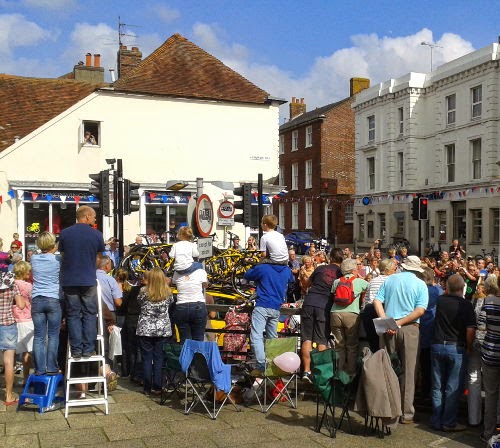
Official cars and motorcycles started to whip through.  Police went by in flashes of acid yellow followed by hot orange motorcycles. As the crowd and excitement built, every vehicle was applauded. Cars with spare bicycles came and went.  Smart phones held at arm’s length snapped everything to do with the race.  I scampered up the flower shop’s steps, not caring that I looked ridiculous in my hairdressers robe. Others stood on ladders and chairs from their shops and fathers put excited children on their shoulders.

As the big moment approached, the High Street was closed and the crowd, who had waited so patiently by the bank, surged forward. The yellows and oranges flashed by quicker and quicker, sounding horns and sirens as they went. By now the anticipation was almost unbearable. Heads snapped to attention and cameras were raised for every movement. The sound of a helicopter overhead could only mean one thing. The rotors seemed to say, “They’re coming, they’re coming.” With glimpses of helmets and Lycra seen between bobbing heads, Wiggo and the others were here - and then, they were gone.

*  *  *  *  *  *  *


Photos and videos of the race

Saturday, 23 August 2014

The Animals of Manor Park go Dancing

Manor Park is big estate in a small country town. Wild animals slip quietly through gardens avoiding humans, cats, dogs and each other. Mostly. Except for the night of the Margaret ball.

Below ground, a mother was lecturing her children. "This is our big chance to go up in the world and we must all be on our best behaviour."

Her husband, Ratty, reassured them "We're on the up. 'umans love us so much they leave takeaways specially for us. And look all around yer. They've left all these fantastic cracks in this sewer ..."

"Tunnel." declared mother firmly and looked sternly at the kits. "What ever you do, don't say sewer in front of the over ground folk." The youngsters squealed with excitement.

Their mother hushed them. "Remember the rules. No being seen or heard dancing by Humans." She emphasised the H.

Ratty added "And no eating fellow dancers."


Scabious, the youngest kit, shuddered as she imagined a fox pouncing.

A few minutes scamper along the darkest gutters and they arrived at the fairy garden. This garden guards the secret entrance to the dancing ground. It had been created by a human family who, sweetly, thought it was their own idea.

A rabbit peeped out from behind a wall. "Good to see you again Ratty. Lovely family. This way. Quickly! Now!"

"Was the dance named after the late Margaret Thatcher?" asked Ratty, trying to impress with news he had seen in a discarded paper.


"Who was she?" asked Bouncer, a large and slightly dim looking rabbit.

"She was King of the humans." replied old Brock. The badger went on, "No, the dance was named after the Princess who provided the prize. Well, when I say provided, my great-great grand father said she threw it away. He was the first badger to walk on his hind legs, you know." He would go on about it all night given half a chance.

A squirrel chattered "Who is the Master of Ceremonies this year? Surely it won't be Tawny again? Not after that unfortunate incident with the mouse?"


When he paused for breath, the rabbit replied, "A peacock is coming from the Other Side of the Road."

There were sharp intakes of breath all round. "Ugh!" grunted a young hedgehog. "He must be really brave."

The peacock strutted in with his tiny head held high.  He was nervous but not because of the road. He knew that he was going to have to give scores and he wasn't very good at numbers.


Old Brock gave the trophy to the peacock. "You'll be giving that back by the end of the evening."


"No chance, matey." sneered a fox. "I was born behind a nightclub in Brighton and have taught my new pals some sharp moves."

They glared at each other. The rivalry between the badgers and the foxes had started with the first dance and had continued as houses engulfed their dancing ground.

The peacock fluttered onto a wall and announced the foxtrot.  The band of grasshoppers, led by a blackbird, struck up the tune and the foxes whirled around the narrow road between the garage doors.


A squirrel nudged her sister as two handsome fallow bucks arrived, then turned to Scabious and remarked "Your costumes are brilliant!"


The crisp packet crackled as the young rat adjusted the rubber band that kept it in place and said. "Thank you. We copied them from Strictly Come Dancing."


The hedgehog looked sad and said that one of her children had choked on a rubber band like that. That stopped the conversation for a moment. The rabbit sighed "I wish humans wouldn't drop litter".

"I dunno." said Scabious, scratching. Her mother nudged her and glared at the errant paw. The youngster continued brightly. "We rats love litter, it's the next best thing to sewers."

Her mother's smile froze and she hastily changed the subject. "The foxes have finished. They're very good." A badger harumpfed and the bats took to the air.Their aerial display drew plenty of oooos and ahhhs from the younger animals.

A fox was rather critical "They seem rather ragged this year."

The badger's waltz was a stately delight. Such powerful animals but so much in love, even after all these years.


The rats went all out in a Samba. The mice clapped their encouragement knowing that no small animals ever won. The only question was - Would the badgers or the foxes take the trophy home this year?


The handsome deer found the narrow road rather cramped.
The squirrels were sweet if a little out of time. The rabbits danced last but the effect was spoilt by the couples' over-amorous behaviour.

The peacock squawked to get everyone's attention and announced the top three. "In third place with four points, the rats. In second, with five points the badgers, and in first." He hesitated, frantically trying to remember, "First with five points plus another one, the Foxes."

The head fox stood up and bowed.


"Not so fast" said the peacock. Remember that points are deducted for those who disobey the rules.  You and young Reynard were seen practising your steps by a human. For this I deduct two points, making", He looked down at his toes, "four."


The badgers looked unbearably smug.


"And," continued the peacock, glaring at Old Brock, "You. YOU, who should know better, allowed yourself to be seen, walking on your HIND LEGS, by a human." Brock hung his head. "For this I deduct one point." A quick glance at the toes, "Making four."


The badgers and the foxes glanced at each other. Would there be a dance off? With light rimming the Eastern skyline, time was running short.


"However" said the peacock, "I thoroughly commend our newest team, the Rats, for their costumes. For this I give them a bonus of two points making - six!"


Excited squeals greeted the news. Ratty pushed Scabious forward. The Peacock placed the engagement ring on her head, like a tiny crown, and said "Well done all of you. You've done your species proud."

Inspirations:


Two fallow deer that visit our Manor Park garden.
 
  • Humans' habit of discarding food, then moaning about vermin
  • Rumours that there is a feral flock of peacocks somewhere in Uckfield
  • A fairy garden built by a local family - featured in the One Dad 3 girls blog
  • A story that Princess Margaret broke off her engagement round our way somewhere.